

If you’ve been dealing with persistent pain for a long time, there’s a good chance you’ve already tried several different approaches.
Physiotherapy, chiropractic treatment, massage, stretching, yoga, Pilates or strength training may have helped to some degree. Sometimes even provide temporary relief. But for many people, the pain eventually returns, moves to another area or never fully resolves.
One of the key differences with Functional Patterns is that it looks at the body more globally, rather than focusing only on the area where pain is being felt.
When someone has knee pain, it makes sense to look at the knee.
Similarly, someone with shoulder pain may be given exercises for the shoulder and the muscles surrounding it. while someone with lower-back pain may be given exercises to strengthen their back or core.
Sometimes this can be appropriate.
But when pain has persisted for months or years, focusing only on the area that hurts may not tell the whole story.
The area where you feel pain isn’t necessarily the only part of the body contributing to it.
Your body doesn’t move as a collection of completely separate parts. When you stand, walk and move, different areas of your body have to work together.
So a problem in one area can sometimes influence what happens somewhere else.
Take knee pain as an example.
It would be easy to assume that the solution is simply to strengthen the muscles around the knee – such as the quadriceps, hamstrings and glutes.
But the way the rest of the body moves can also influence how much stress is placed on the knee.
For example, the way your pelvis and upper body rotate when you walk can affect how force travels through your legs. If that movement isn’t working effectively, the knee may have to compensate and take on more stress.
In that situation, strengthening the muscles around the knee may still be useful, but it may not address all of the factors contributing to the problem.
This is why it can be important to look beyond the painful area itself.
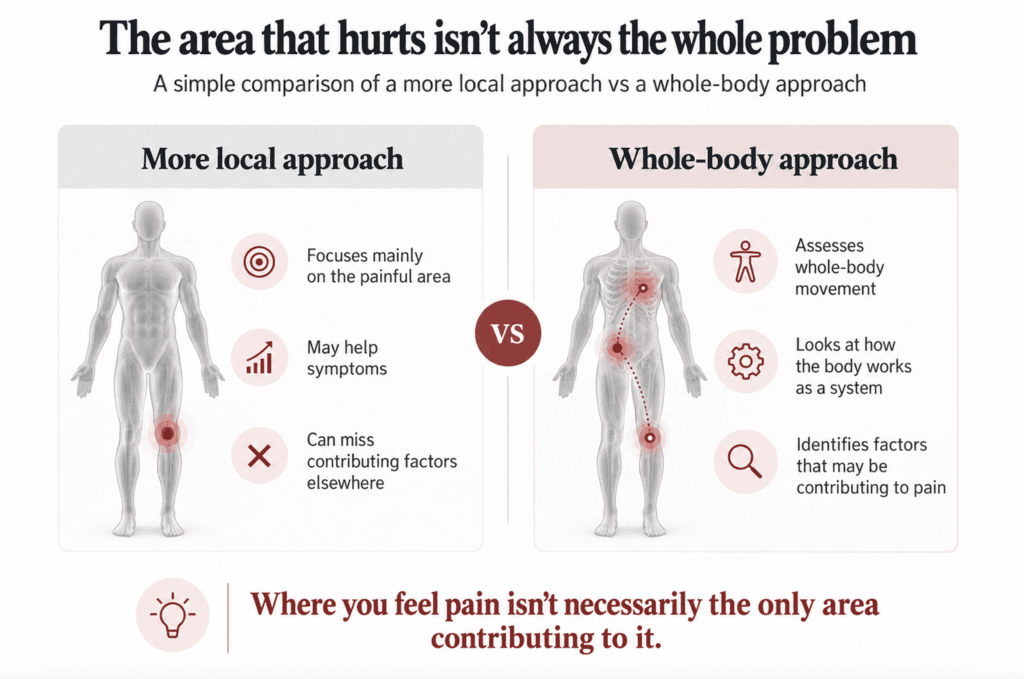
A local approach may focus mainly on the painful area. A whole-body approach asks what else may be influencing how that area is being loaded and used.
Functional Patterns aims to understand how different parts of your body are interacting rather than looking at the painful area in isolation.
Instead of simply asking:
“Where does it hurt?”
we also want to understand:
“What might be causing this area to take on more stress in the first place?”
That means looking at how your body functions as a whole and identifying movement patterns that may be contributing to the problem.
From there, exercises can be used to improve how the different parts of your body work together, with the aim of reducing unnecessary stress on the painful area and improving your overall movement.
If you’ve experienced pain for a long time and previous treatments have only provided temporary relief, repeatedly focusing on the painful area may not be enough.
It’s likely that the treatments you’ve used have missed certain variables that were contributing to the problem.
By taking a more whole-body approach, Functional Patterns aims to identify those broader factors rather than only treating the symptoms where they appear.
If you’ve been dealing with persistent pain and previous approaches haven’t provided lasting relief, you can book a free 15-minute phone call with me.
We’ll talk through what you’ve been experiencing, what you’ve already tried and whether Functional Patterns could be a suitable approach for you.